The development of privileged chiral architectures which are versatile for various chiral ligands or organocatalysts preparation with superior performance in a variety of organic transformations has significant pushed forward the advancement of asymmetric catalysis. However, only a few scaffolds could be seen as privileged chiral backbone, including BINOL-, SPINOL-, TADDOL-based architectures. In the Wang lab, our project mainly aims at the design of the novel heteroatom (Si, Ge etc.)-centered spirocyclic ligand skeletons, developing new asymmetric methods for construction of those heteroatom-centered spirocyclic skeletons, preparation of various types of heteroatom-centered spirocycle-based ligands and catalysts, and further studying their structure-function relationships in organic synthesis.
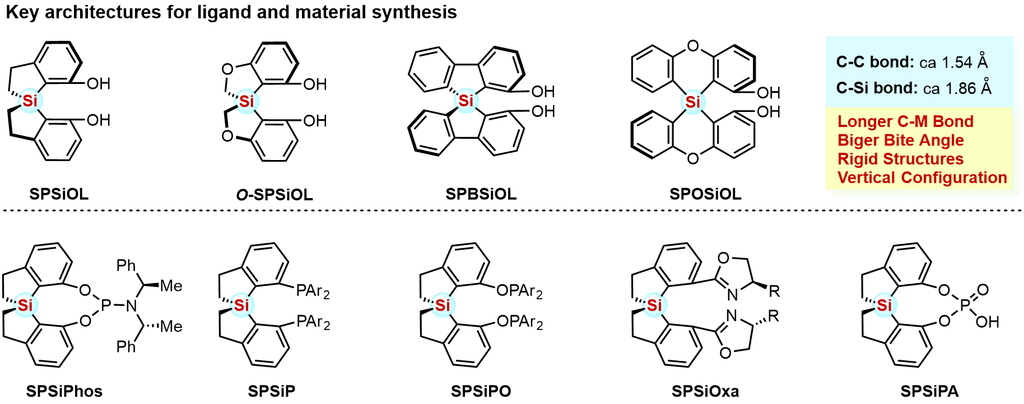
For representative reviews, see:
(a) Chang, X.; Ma, P.-L.; Chen, H.-C.; Li, C.-Y.*; Wang, P.* Asymmetric Synthesis and Application of Chiral Spirosilabiindanes. Angew. Chem. Int. Ed.2020,59, 8937–8940.
(b) Chen, H.-C.; Chang, X.* A Journey to SPSiOL, a New Type of Chiral Ligand Scaffold. Chin. J. Chem. 2020, 38, 1203–1204.
(c) Yang, L.; Xu, W.-Q.; Liu, T.; Wu, Y.; Wang, B.-Q.*; Wang, P.* Concise Synthesis and Application of Enantiopure Spirobiphenoxasilin-Diol and Its Related Chiral Ligands. Chem. Commun. 2021, 57, 13365–13368.